Monday, December 1, 2014

Reflection: Answering Our Shamelessness (November 30, 2014)

9 And Jesus began to tell the people this parable: “A man planted a vineyard and let it out to tenants and went into another country for a long while. 10 When the time came, he sent a servant to the tenants, so that they would give him some of the fruit of the vineyard. But the tenants beat him and sent him away empty-handed. 11 And he sent another servant. But they also beat and treated him shamefully, and sent him away empty-handed. 12 And he sent yet a third. This one also they wounded and cast out. 13 Then the owner of the vineyard said, ‘What shall I do? I will send my beloved son; perhaps they will respect him.’ 14 But when the tenants saw him, they said to themselves, ‘This is the heir. Let us kill him, so that the inheritance may be ours.’ 15 And they threw him out of the vineyard and killed him. What then will the owner of the vineyard do to them? 16 He will come and destroy those tenants and give the vineyard to others.” When they heard this, they said, “Surely not!” 17 But he looked directly at them and said, “What then is this that is written: “ ‘The stone that the builders rejected has become the cornerstone’? 18 Everyone who falls on that stone will be broken to pieces, and when it falls on anyone, it will crush him.” Luke 20:9-18

We are not people who are offended by shameful behavior. Instead, we tend to take the news of people doing shameful, reprehensible, and shocking things in stride. We've become numb to the shame of others and, as a result, unaware of our own shamefulness. The shocking behavior of the tenants in the parable Jesus told doesn't shock us in the way that it did the people who first heard this story. If if did -- or if we'd let it -- we'd be moved to action. Fortunately, our Savior answered our shamelessness for us. Freed from the shame that we tend to deny, we can live radical new lives in Christ that may even shock or shame the world around us.

Click here to listen to the sermon "Answering Our Shamelessness" (or right-click to download the MP3 file).

Reflection: A Question Worth Considering (November 18, 2014)

6 “With what shall I come before the LORD, and bow myself before God on high? Shall I come before him with burnt offerings, with calves a year old? 7 Will the LORD be pleased with thousands of rams, with ten thousands of rivers of oil? Shall I give my firstborn for my transgression, the fruit of my body for the sin of my soul?” 8 He has told you, O man, what is good; and what does the LORD require of you but to do justice, and to love kindness, and to walk humbly with your God?  Micah 6:6-8

Click here to listen to the homily "A Question Worth Considering" (or right-click to download the MP3 file).

Saturday, November 8, 2014

Reflection: Salt Made Salty Again (November 08, 2014)

Matthew 5:13–16
[Jesus said:] “You are the salt of the earth, but if salt has lost its taste, how shall its saltiness be restored? It is no longer good for anything except to be thrown out and trampled under people’s feet. You are the light of the world. A city set on a hill cannot be hidden. Nor do people light a lamp and put it under a basket, but on a stand, and it gives light to all in the house. In the same way, let your light shine before others, so that they may see your good works and give glory to your Father who is in heaven.”


Saturday, November 1, 2014

Devotion: Shattering the Myths of Heaven (Revelation 7:9-17)

9 After this I looked and there before me was a great multitude that no one could count, from every nation, tribe, people and language, standing before the throne and in front of the Lamb. They were wearing white robes and were holding palm branches in their hands. 10 And they cried out in a loud voice: "Salvation belongs to our God, who sits on the throne, and to the Lamb." 11 All the angels were standing around the throne and around the elders and the four living creatures. They fell down on their faces before the throne and worshiped God, 12 saying: "Amen! Praise and glory and wisdom and thanks and honor and power and strength be to our God for ever and ever. Amen!" 13 Then one of the elders asked me, "These in white robes-- who are they, and where did they come from?" 14 I answered, "Sir, you know." And he said, "These are they who have come out of the great tribulation; they have washed their robes and made them white in the blood of the Lamb. 15 Therefore, "they are before the throne of God and serve him day and night in his temple; and he who sits on the throne will spread his tent over them. 16 Never again will they hunger; never again will they thirst. The sun will not beat upon them, nor any scorching heat. 17 For the Lamb at the center of the throne will be their shepherd; he will lead them to springs of living water. And God will wipe away every tear from their eyes." 
Revelation 7:9-17

When people talk about heaven it becomes very apparent that we live in confusing times.

On one hand, many people in our culture talk about their dogs and cats having souls and living on in another life after they die.

On the other hand, just as many (or more) people embrace the idea that the human race is the result of millions of years of evolutionary mutations and that we are physical, not spiritual, beings with no existence after death.

It's even more mind-boggling that there are a good number of people who embrace both of these ideas!

The growing secularism of our culture has forced people to find new ways to deal with the deaths of friends and loved ones (and even pets). A casual reading of the obituaries in the newspaper or on-line reveals a number of these coping methods and the myths of heaven that have been formed around them.

Those who see humans as physical beings without souls have crafted a myth that there is no heaven, only nothingness. When a loved one dies, they seek comfort in the hope that the person will live on in the memories of those still alive.

Those who are "spiritual" apart from an "organized religion" promote the myth that heaven is an experience for every person of the human race. Thinking of their deceased loved ones as having entered into a cosmic oneness to which we are all somehow connected is supposed to help them cope with their loss.

The myth embraced by the millions of people in our nation who are culturally Christians, but not committed followers of Jesus, is that heaven is an upgraded and much improved continuation of this present life. Imagining their departed loved ones as newly minted angels who are watching over them is supposed to ease their grief.

As popular as these myths of heaven have become in our culture and in the American church, God's Word about heaven shatters them. The reality of heaven, though only given to us in small glimpses, eclipses all of our myths and brings us genuine comfort in the face of death.

The reality of heaven presented in the image of the saints of God dressed in white robes and gathered in His presence stands in vivid contrast to the myths of heaven crafted by our culture.

The reality of heaven is the fullness of life, not nothingness. It is being in the unlimited presence of the One who created all things, not an ambiguous connectedness to the cosmos. It is being free from the pain, sorrow, and suffering of this world, not condemned to observe it from afar.

Furthermore, it is centered not in us and our limited imaginings, but in the Lamb who is the author and essence of all that is real.

Best of all, the reality of Heaven awaits us and now belongs to those who have gone before us by God's grace through faith in Jesus Christ whose blood has washed away our sins and whose righteousness clothes us so that we too may stand in the assembly from every nation, tribe, people, and language in His glorious presence forever.

Friday, October 31, 2014

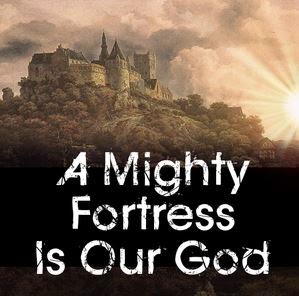
Devotion: A Fort Made Of ... (Psalm 61:1-4)

1 Hear my cry, O God, listen to my prayer; 2 from the end of the earth I call to you when my heart is faint. Lead me to the rock that is higher than I, 3 for you have been my refuge, a strong tower against the enemy. 4 Let me dwell in your tent forever! Let me take refuge under the shelter of your wings! Psalm 61:1-4


Forts made up a big part of my childhood experience. My brothers and I, along with our playmates, were always building some kind of fort. In the wintertime, we made forts of snow. In the summertime, we hobbled together salvaged wood, cardboard, and plastic sheeting to build forts. When the weather was nasty and we were stuck indoors, we made forts out of blankets, cushions, and books. But the fort that stands out most in my memories was the fort I made out of bales of straw in the hayloft of my grandparents' barn. Secure in my fort, I successfully fended off the valiant assault of my two brothers in in the great corncob war. It was the stuff of legends.

The purpose of forts is to provide safety and security — or at least a sense of them. While they may have given us a feeling of being safe and secure, none of the forts of our childhoods could protect us from any real threat. A fort made of snow, salvaged building materials, or bales of straw, let alone blankets and pillows, cannot afford any protection against the people or things that would harm a child. Thankfully, most of us grew up without the need of stronger forts than those of our playtime. But now that we have grown up, we need a fort in our adult lives that can defend us against those things, forces, and people that are actively seeking to harm and destroy us. Unfortunately, many adults go through life constructing forts of proverbial snow or straw or blankets to fend off the pain and suffering of broken relationships, abuse, betrayal, crime, shattered dreams, and seemingly hopeless circumstances.


As we celebrate the 497th anniversary of the beginning of the Reformation, we are reminded that we have a fort that is stronger than everything that assails us in this life. More than a fort of our own construction, this fort is a fortress that God has built for all who look to Him for their safety and security. It is not a flimsy fort made out of the materials at hand, but a fortress crafted according to God's eternal plan and hewn from the Rock of our salvation. When we take refuge in this fort we are assured that in it is "our refuge and strength, an ever-present help in trouble." This is a fort made of love, of grace, of power, and of promise. "The God of Jacob is our fortress."

Thursday, October 9, 2014

Reflection: The Immeasurable Love of Our Immeasurable God (October 9, 2014)

Homily from chapel service at the LCMS International Center on October 9, 2014.

Ephesians 3:13-21
13 So I ask you not to lose heart over what I am suffering for you, which is your glory. 14 For this reason I bow my knees before the Father, 15 from whom every family in heaven and on earth is named, 16 that according to the riches of his glory he may grant you to be strengthened with power through his Spirit in your inner being, 17 so that Christ may dwell in your hearts through faith—that you, being rooted and grounded in love, 18 may have strength to comprehend with all the saints what is the breadth and length and height and depth, 19 and to know the love of Christ that surpasses knowledge, that you may be filled with all the fullness of God. 20 Now to him who is able to do far more abundantly than all that we ask or think, according to the power at work within us, 21 to him be glory in the church and in Christ Jesus throughout all generations, forever and ever. Amen.


Saturday, August 2, 2014

Devotion: Costly Dissatisfaction (Isaiah 55:1-5)

Click here to listen to an audio version of this devotion (or right-click to download the MP3 file).

1 "Come, all you who are thirsty, come to the waters; and you who have no money, come, buy and eat! Come, buy wine and milk without money and without cost.  2 Why spend money on what is not bread, and your labor on what does not satisfy? Listen, listen to me, and eat what is good, and your soul will delight in the richest of fare.  3 Give ear and come to me; hear me, that your soul may live. I will make an everlasting covenant with you, my faithful love promised to David.  4 See, I have made him a witness to the peoples, a leader and commander of the peoples.  5 Surely you will summon nations you know not, and nations that do not know you will hasten to you, because of the LORD your God, the Holy One of Israel, for he has endowed you with splendor." 
Isaiah 55:1-5

Dissatisfaction is a two-edged sword. On one hand, dissatisfaction fuels creativity and progress. On the other hand, the drive to overcome dissatisfaction can consume a person and still leave him dissatisfied. It is as Douglas Horton put it, "Change occurs in direct proportion to dissatisfaction, but dissatisfaction never changes." However, the degree of dissatisfaction does change. It seems that the people of our culture have grown to new depths of dissatisfaction. Everything we've come up with to overcome it has failed. We've used entertainment, technology, materialism, consumption, sex, drugs, politics, and more to try to quench our dissatisfaction, but we're still dissatisfied. To make matters worse, we have spent ourselves, our money, and the limits of our borrowing power to our greater dissatisfaction.

The question put to God's people through the prophet Isaiah is just as relevant today as it was 2,600 years ago: "Why spend money on what is not bread, and your labor on what does not satisfy?" (Is. 55:2). We've spent our time, our money, our talents, our relationships, our very selves in efforts to find satisfaction. Yet the result has been a deepening rather than a lessening of our dissatisfaction. Far from being a healthy dissatisfaction that leads to creativity and innovation, our dissatisfaction has carried us into all sorts of destructive choices and behaviors. It's been a costly dissatisfaction.

Despite its destructive results in our culture, dissatisfaction is still a helpful experience for us. Our problem isn't being dissatisfied, but in how we've responded to our dissatisfaction. We've turned to all of the wrong things to find satisfaction.  The result of turning to these things has been a downward spiral of dissatisfaction. The question, "Why spend yourself on what does not satisfy?" challenges us to turn away from the things that have failed to ease our dissatisfaction let alone bring us any satisfaction. Along with that challenge comes God's gracious invitation: "Come, all you who are thirsty, come to waters; and you who have no money, buy and eat!" (Is. 55:1). Only when we reject our efforts to find satisfaction in the things of this world can we find satisfaction in the things of God. He has paid the price for the satisfaction of our souls. Ours was a costly dissatisfaction, but He freely satisfies all those who come to Him.